7 Steps to Start Forex Trading for Beginners Without Blowing Your First Account
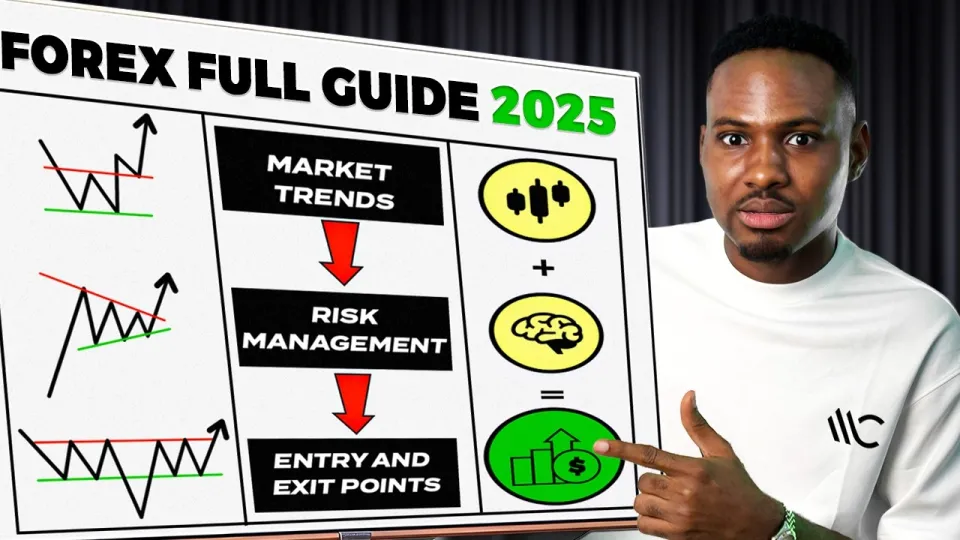
Video: How To Start Forex Trading For Beginners’ 2025 (Full Course)
Want articles like this for your own video to promote it on YouTube and Google? Order them through the Telegram bot @sat_sit_bot. Articles with your video embedded are written and posted by the bot itself — on popular topical sites (no ads). Free trial — 50 articles.
· based on the channel Jeffrey Benson Forex
Key takeaways
- Forex is the exchange of currency pairs, and retail traders profit from price changes rather than buying the currencies themselves
- The market runs 24 hours a day, five days a week, split into four sessions: Sydney, Tokyo, London and New York
- A beginner needs three tools: a broker account, a trading platform such as MT5, and a charting or journal setup
- Risk per trade is the single biggest survival factor — most beginner accounts die from position size, not from bad analysis
- Jeffrey Benson Forex structures its full beginner course around definitions, tools, strategy, a first trade and common mistakes
Forex trading for beginners means opening a position on the price of one currency against another — for example EUR/USD — through a broker, and profiting if the exchange rate moves in your direction. You do not buy euros or dollars physically; you trade a contract whose value follows the pair. The practical starting point is a free beginner course such as the one from Jeffrey Benson Forex, and you can join the Fire Pips FX student plans to follow a structured path instead of piecing tutorials together.
What forex trading actually is and what you are trading
Forex is the largest financial market in the world, and a retail trader participates by speculating on currency pairs rather than exchanging money for travel. Every pair has a base currency and a quote currency: in EUR/USD, the euro is the base and the dollar is the quote, so a price of 1.0850 means one euro costs 1.0850 dollars. When you go long, you expect the base to strengthen; when you go short, you expect it to weaken.
Prices move because of interest rates, inflation data, employment reports, central bank decisions and capital flows between economies. Currencies are quoted in pips — the fourth decimal place for most pairs, the second for yen pairs — and your profit or loss is pip movement multiplied by position size. A standard lot is 100,000 units of the base currency, a mini lot is 10,000 and a micro lot is 1,000, which is why micro lots are the sensible starting size for a small account. Leverage lets you control a larger position with less capital, but it magnifies losses in exactly the same proportion as gains.
How the forex market works across the four sessions
The forex market trades around the clock from Monday morning in Sydney to Friday evening in New York, and liquidity is not equal across that window. The day is divided into four sessions: Sydney, Tokyo, London and New York. London and New York overlap for a few hours, and that overlap is typically the most liquid and most volatile period for EUR/USD, GBP/USD and other major pairs.
Three structural facts matter more than any indicator for a beginner:
- Majors are cheaper to trade. EUR/USD, USD/JPY, GBP/USD and USD/CHF have the tightest spreads; exotic pairs can carry spreads several times wider.
- Volatility clusters around news. Rate decisions and US employment data move price fast, and stops placed too close get hit regardless of your analysis.
- There is no central exchange. Forex is an over-the-counter market, so your broker is your counterparty and the quality of that broker matters as much as your strategy.
The tools you need before placing a single trade
A beginner needs three things: a regulated broker, a trading platform and a way to record decisions. MetaTrader 5 (MT5) is the platform most retail forex traders use, and it provides charts, order types, indicators and a demo account. Jeffrey Benson Forex recommends a specific broker for 2026 and links a setup guide for connecting that account to MT5, which is the same workflow any broker requires.
Before funding anything, do these four things:
- Open a demo account first and trade it for at least a month so that order entry, stop loss and take profit become automatic.
- Check regulation and spreads rather than bonuses; a wide spread on a small account erodes more than any promotion adds.
- Set up a chart template with a clean layout — a higher timeframe for direction and a lower one for entry.
- Keep a trading journal from day one, recording pair, direction, entry, stop, target and the reason for the trade.
Building a basic forex strategy foundation
A workable beginner strategy is a set of rules that tells you when to enter, where to exit and how much to risk, and it should be simple enough to follow on a bad day. Most beginner frameworks combine market structure with a trigger: identify whether price is making higher highs and higher lows or lower highs and lower lows on a higher timeframe, then look for an entry in the direction of that structure on a lower timeframe.
Support and resistance, trendlines, moving averages and candlestick patterns are all ways of describing the same thing — where buyers and sellers previously reacted. Pick one or two, define the exact conditions in writing, and backtest them on historical charts before risking money. A strategy is only real when you can state its entry rule, exit rule and invalidation point without hesitation.
Placing your first trade without gambling
Your first live trade should be small enough that the outcome does not change your behaviour. The sequence is: choose a pair with a tight spread, decide direction from your higher-timeframe structure, set the stop loss at the level that proves you wrong, then size the position so that the stop equals a fixed percentage of the account — commonly 1% or less for a beginner.
Position size is calculated, not guessed. If your account is $500 and you risk 1%, the maximum loss is $5. On a micro lot, one pip is worth roughly $0.10, so a 50-pip stop fits that risk. This single calculation separates traders who survive their first year from those who do not. Set take profit in advance at a level where the potential gain is at least as large as the risk, and leave the trade alone once both orders are in place.
The mistakes that end most beginner forex accounts
Most beginner accounts are not destroyed by a bad strategy but by position sizing and emotional decisions. The recurring failures are risking 10–20% on a single idea, removing a stop loss to avoid taking a loss, averaging into a losing position, and increasing size after a winning streak. Revenge trading after a loss and overtrading in low-liquidity hours compound the damage.
A second cluster of mistakes is structural: trading without a journal, switching strategies every week, following signal groups without understanding the setup, and treating a demo account as proof of skill. A third is expectation management — forex is not a fast income source, and anyone promising guaranteed daily returns is selling something other than trading skill.
Common beginner questions answered
The most frequent doubts are about time, capital and readiness. Viewers of beginner courses repeatedly ask how long it takes before trading becomes profitable and whether a small account can work at all. The honest answers: expect months of demo and small live trading before consistency appears, and treat a small account as a training ground where the goal is process, not income.
Another common concern is learning from free material versus paid mentorship. Free full courses cover definitions, tools and risk management well, but structured mentorship adds feedback on your own trades, which is the part self-study cannot provide. A third question is about copying trades — it can shorten the learning curve for execution, but it does not teach you why a trade exists, so it works best alongside your own analysis.
Useful links
- Fire Pips FX student plans — structured course and mentorship access
- https://t.me/firepipsignals — one free signal per day
- https://my.assexmarkets.com/auth/register?partner_code=1699134 — broker registration recommended in the course
- https://t.me/jeffreybenzhelpbot — premium signal group subscription
Bottom line
Forex trading for beginners comes down to a small number of decisions repeated consistently: understand what a currency pair is, trade liquid pairs during active sessions, size every position from a fixed risk percentage, and journal the results. The full course from the Jeffrey Benson Forex channel is a solid starting curriculum because it moves from definitions to tools, strategy, a first trade and the mistakes that cost money — in that order. Work through it with a demo account open, then move to a small live account only when your rules are written down. When you are ready for structure, review the Fire Pips FX plans and pick the level that matches how much feedback you need.
Source: How To Start Forex Trading For Beginners’ 2025 (Full Course) · Markdown version
Questions & answers
How much money do I need to start forex trading?
You can open a live account with a few hundred dollars, but the amount matters less than the risk per trade. With a $500 account risking 1% per trade, the maximum loss is $5, which fits micro lots. Treat the first account as tuition for learning execution and discipline rather than as an income source.
How long does it take to become profitable in forex?
Most beginners need several months of demo trading and then a stretch of small live trades before results become consistent. The bottleneck is usually risk management and emotional control, not chart knowledge. Judge progress by whether you follow your written rules, not by weekly profit.
Is it better to learn forex from free courses or paid mentorship?
Free full courses cover the essentials well: what forex is, how sessions work, which tools to use and how to size positions. Paid mentorship adds feedback on your own trades, which self-study cannot replicate. A sensible path is to finish a free course, trade a demo account, then pay for structure if you still need correction.
Can I just copy someone else's forex trades instead of learning?
Copying trades can help you see how execution and risk management work in practice, and it removes decision pressure early on. It does not teach you why a position was opened or when to exit, so it is best used alongside your own analysis and journal. Relying on signals alone leaves you dependent on someone else's judgment.